Thursday, August 23, 2012

Dawning (2009)


I have been finding so many low budget horror films lately that have really impressed me. They're all from the last few years and they utilize HD in the best possible way. A few years ago, I kept saying that HD makes movies so real looking that they no longer look like movies. For fictional films, too real isn't always good. But if it is balanced out with the right lighting and good sound design, HD can be glorious.

Dawning is a movie that has gotten way too many negative reviews. It uses HD extremely well, it carries the acting chops from its small cast and the story is original and suspenseful. It's writer/director Gregg Holtgrewe's second film. The only actor I recognized was Najarra Townsend, who is best known for television work and the brilliant 2005 film Me and You and Everyone We Know. In Dawning, she plays Aurora. She and her brother Chris are headed to visit their father and step-mother in the forest of Wisconsin. Chris drives while Aurora sleeps, and all of a sudden a figure jumps across the road and he swerves to avoid it. Aurora wakes, Chris tells her about almost hitting someone and she offers to drive. When they get to the cabin, everyone is on edge. There is a lot of family history that is revealed through conversation and it's pretty clear that everyone is still healing and dealing with ongoing pain in their own way. Aurora takes the family dog out for a walk, a few minutes later she returns without her, saying that she wandered off. The family goes to look for her and find her in some bushes, bleeding to death. This is only the beginning of the weird night. Everyone is hearing each other say things that they aren't actually saying. Much of it are hurtful and sarcastic comments. This starts the fighting and they all start airing their dirty laundry. Dad, who is a recovering alcoholic, starts drinking again. Then a mysterious man shows up. He makes his way inside the cabin and holds a gun at the family. I wont say anymore about what happens, but the tension and suspense build in this extremely unconventional film. It's part home invasion thriller and part supernatural Wendigo tale. The movie never mentions The Wendigo, but it takes place in the part of the United States where the legend comes. The Algonquians thought of it as a malevolent and cannibalistic spirit that could possess humans. Pretty scary stuff. The concept first appeared in horror fiction in the 1910 Algernon Blackwood story "The Wendigo".

Dawning is a movie that makes good use of its time. It never wear itself out, but it's only 80 minutes. The story unfolds very slowly and they never spoon feed you information about The Wendigo. I think the filmmaker trusted that his audience would get it, but unfortunately it went over a lot of people's heads. I'm not giving anything away by giving my interpretation, hopefully it will help others enjoy it more. With this information, just sit back and enjoy a film about the complex workings of a family unit that has been torn apart and now are forced to co-exist in a confined space. This brings to mind Roman Polanski's Knife in the Water (1962) which uses the same feeling of isolation and terror. Only Dawning puts it all on dry land and adds a nice supernatural element to the terror. 


The Haunting of Whaley House (2012)


The Haunting of Whaley House sets itself up with three different but unlikeable characters. The leader is a skinny, mean spirited white guy and his two friends are a fat guy and a black guy. The stand in front of a house that is supposed to haunted. The leader wants to go inside, the others aren't so excited about it. They have a two second argument about who's better- Argento or Fulci. Which is an age old argument, but why are they discussing it here? Then all of a sudden a figure of a woman holding a candle appears in a window. Startled, the leader walks backward a couple steps only to get run over by a car. "Danse Macabre" by Camille Saint-Saëns begins t play as the opening credits roll. Which is a nice choice. It's a classical piece that embodies the creepiness of old houses and ghost stories. 

We then get the background on the history of the house via a tour that is doing a walk through. It's typical and not worth mentioning here. We see things going on in the background that the characters do not. One of the women on the tour begins to see things, which escalates into her going into convulsions and needing to be taken to the hospital in a ambulance. What happens next is where the movies lost me- a conversation between the new tour guide and the tour guide who's been working at the house for thirty years. The young woman admits that she doesn't believe in ghosts but is working as a tour guide to put herself through medical school. Really? Medical school? The older woman talks about how the ghosts have to be respected and one should never go in the house at night, because that is their time. 

This, of course, sets up a conversation with a group of kids (who are drinking in a cemetery during the day. Again, really?) They discuss  plans to go inside the house to explore after dark. One of them brings along a famous T.V. psychic who regularly does ghost hunting shows. He inadvertently reveals himself to be a fake almost immediately. The rest of the group is made up of two dimensional and stereotypical characters. A few of them crack jokes that the rest of the cast thinks is hilarious, but to me a lot of it was racist, sexist and homophobic. This is obviously nothing new for teens in horror movies, but it's still unfortunate. 

People walk through the dark, People die in gruesome ways. Eventually the police show up only to tormented by the real Whaley family. And then one of the group of kids becomes possessed. This movie is based on a real house in San Diego that is thought to be haunted. It has been explored on all of the cable ghost hunting shows. I'm guessing all with the same results. Let's face it, there has never been anything on those shows that proves anything. And every episode I've seen is interchangeable. It's a sometimes entertaining hoax, but a hoax nonetheless.

Toward the end, it starts to get a little scary. The members of the Whaley family look like ghosts from Disneyland's Haunted Mansion. They move slowly in and out of shadows and have dark circles around their eyes with creepy grins on their faces. But overall there is nothing new here. All the haunted house cliches are present. Even though the production values are better than most independent horror films, its story is just as weak as any paint by the numbers Hollywood production. Avoid this one. 


True Romance (1993)


Tony Scott ended his life this week. I have never been a fan, far from it. But I do have respect for his accomplishments and I understand that his films are loved by a certain type of movie fan. It's just not me. Roger Ebert wrote a tribute to him a few days ago, calling him a master. I think that's going too far. When someone dies, all of a sudden they are loved by everyone. Probably because we are all going to die one day too. And I think everybody hopes that people will say nice things about them after they are gone. 

Still, I wanted to pay tribute to him somehow. So I decided I'd do it with an honest movie review. I first saw True Romance when it was released on video. I never saw it in the theater. A year later, screenwriter Quentin Tarantino would become a house hold name. Nineteen years later I'm watching it again. All I remember about this movie is not liking it- thinking it was too long, too flashy and hip, and that Tony Scott's jump cuts and editing were exhausting. And what was up with Gary Oldman's hair? So it's time to give this film another shot. Let's see what we find in 2012. 

The very first scene in the film has Clarence Worley (Christian Slater) sitting in a bar, flirting with a woman. Quentin Tarantino's writing is instantly recognizable. He borrows ideas from other films, adds in pop culture references and obscure references and puts it all together with snappy dialogue. He's a natural at this, It was evident from the beginning, but he's gotten so much better over the years. Worley is asking this woman to go to a Kung Fu movie with him. She kind of rolls her eyes and politely declines. This entire scene is kind of like watching Travis Bickle at work in Taxi Driver. But Clarence is obviously more evolved because he asks her if she wants to see the movie and tells her up front what it is. And it's just a Kung Fu movie, not a porno. 

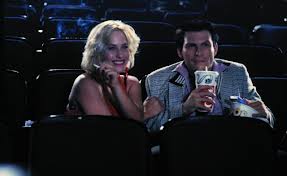
The movie is narrated by Alabama Whitman (Patricia Arquette). We meet her when she walks into the movie theater and the life of Clarence. She sort of forces herself on him and invades his space, but he welcomes it because he is longing for some human contact. He gets that with Alabama and a whole lot more. And we get an intense non-stop action movie. 

While Tarantino borrows plot points from some films that he loves, director Tony Scott borrows from himself. The first love scene between Clarence and Alabama is lit with dark blue light and looks an awful lot like the love scene in Top Gun (1987). After they make love, Alabama confesses that their meeting in the theater was arranged by a friend of Clarence's. Alabama is actually a call girl, but she thinks she's fallen in love with him. They get married, kill her pimp and end up with a bag full of cocaine that someone is looking for. It's time to get out of town. 

True Romance holds up better than I though it would. The cast is pretty amazing. It has everybody from Gary Oldman and Dennis Hopper to Samuel L. Jackson and Christopher Walken, plus there are tons of character actors and actresses whose faces you will recognize. The acting is perfect all around. It's the direction that I still mostly have a problem with. The movie is still exhausting and the action sequences which are like the whole second half of the movie- have those quick cuts and crazy editing, it's more confusing and disorienting than entertaining. There's also an awful soundtrack of what sounds like some stock sound from the 80s, it's a xylophone with a kind of calypso feel. It's the same few notes and it repeats over and over throughout the entire movie. Some other songs chosen are songs that are public domain or really cheap, because you hear them in everything. It's distracting and detracts from the movie as a whole. Even Tarantino's fancy dialogue runs out of steam and gets old after a while. 

The great thing about a movie like this, is that even though I didn't like it much, you can read my review and still think it sounds great. If it does, by all means go and see this film. But may I make a suggestion? If you are looking for a movie with two lovers on the lamb, you'd be better off seeing Oliver Stone's Natural Born Killers (1994) or Terrence Mallick's Badlands (1973). Rest in peace, Tony Scott. You were great at doing what you were trying to do. It wasn't for me, but I admire you for it nonetheless. 


Tuesday, August 21, 2012

Two in the Wave (2010)


This is not a popular thing to say, but I've never cared much for Jean-Luc Godard's films. A few I flat out hate (like A Woman is a Woman from 1961) and others I'm indifferent to (Breathless). But one that I absolutely am in love with is Pierrot le Fou (1965). His star, Anna Karina, has a quality that I can't describe in words. But it is a quality that I've only seen in three actresses all throughout the history of film. Those three are Audrey Hepburn, Anna Karina and Audrey Tautou. 

One of my favorite directors of all time is François Truffaut. I've seen most of his films and haven't hated or been indifferent to a single one. His Antoine Doinel series is one of cinemas great character studies. The first film in the series, The 400 Blows (1959) is in my top ten favorite films of all time. 

Both of these directors are the subject of the documentary Two in the Wave (2010). They were both equally important to the French New Wave film movement. The fact that I don't care much for Godard is completely irrelevant. He is one of the most important filmmakers in history and he's still alive and making films in his 80s. 

Two in the Wave begins with the death of Truffaut. He died in 1984 of a brain tumor. When he died, Godard was told that there would no longer be anyone who would protect him. This documentary is mostly about their friendship and working relationship. But it strays far from that topic quite a bit and ends up sort of all over the place. It's still interesting for those interested in film history. But if you don't already know about French cinema, you'll probably get lost several times throughout the duration. 

There is quite a bit of emphasis on film criticism, which made me happy. They talk a lot about Andre Bazin, who is considered one of the most respected and influential film critics of the 1940's and 1950's. Truffaut's The 400 Blows is actually dedicated to him. It seems to me that if a filmmaker dedicated his film to a critic today, they would be lambasted for trying to bribe them into giving them a good review. Fortunately for Bazin, he died before the film was released.

The film also deals in great length with other french filmmakers of the time like Eric Rohmer. It really should have been called A Bunch in the Wave. After about the first half hour the film begins to focus. There is some amazing footage of the directors. One in particular that I found fascinating was Godard talking to Fritz Lang. As I watched I started to realize that talking about all of these other filmmakers was important because Truffaut and Godard were both influenced by so many great directors. Even American directors like Howard Hawks and Nicholas Ray. 

I learned quite a bit from watching this. Even though their friendship ended before Truffaut's death, it was interesting to see how Godard and Truffaut would always help each other out, despite their differences. Truffaut wrote the screenplay for Breathless and they co-directed a short film together, A Story of Water (1958). Their camaraderie sort of reminds me of Quentin Tarantino, Robert Rodriguez and Eli Roth. The great thing is that these guys care as much about the movies as Truffaut and Godard. It's not just a job, it's a way of life. So for them to create these same kind of relationships half a century later, is pretty remarkable. I'm almost willing to bet that they don't see the connection. But great art is timeless and universal. And history keeps repeating itself. 


Sunday, August 19, 2012

I Bury the Living (1958)


The notion that good movies need to be really expensive to make money is absolutely ridiculous. The 1950's saw a lot of low budget films cropping up all over the place. Sure, for many films in the horror and science fiction genre at the time, the reason they are so good is because they are so bad. But there are some genuinely erie and entertaining cheapies that came out in the 50's. 

I Bury the Living (1958) has one of those titles that could be way too good for its content (to see what I'm talking about check out I Eat Your Skin from 1964, a real snooze fest). Fortunately it deserves it. I Bury the Living stars Richard Boone of the television series Have Gun - Will Travel. He plays Robert Kraft, the new guy in charge of the local cemetery. Theodore Bikel plays the cemetery grounds keeper. When Bikel shows Kraft to his office, he explains the purpose of a giant map of the cemetery on the wall of the office. Each grave is marked with a pin- a white pin for those who are still living but have already purchased the plot and a black pin for those who are already in their graves. Kraft eventually discovers that the map has the power to end lives and bring people back from the dead. He accidentally puts a black pin where a white pin should be and the owner of the plot dies that day. At first he believes it to be a coincidence, but when it happens again he realizes the truth. 

This movie is really short and it moves slow, but builds tension nicely as a result. The black and white cinematography creates a nice atmosphere that unfolds entirely on the cemetery grounds. There is also some incredible graveyard photography.  The acting is great and movie never gets campy. Even the effects and makeup are good for the time period. Some of it reminded me of Creepshow (1982) but without the vivid colors. Also worth mentioning is the design of the map, which I think was important because it sort of becomes a character or at least an extension of Robert Kraft. The final scenes have an incredible sequence that superimposes parts of the map over areas of the cemetery as Kraft runs around frantically. 

I'm not sure why this film isn't talked about more. It's a great example of a low-budget/high quality film from the 50's. I wish film studios today would realize that so much money is wasted on empty and meaningless crap. I think if the subject matter is good enough, it doesn't matter if it's a multi million dollar picture. People will still be interested. 


Saturday, August 18, 2012

Friends With Kids (2011)


I hated the sh!t out of the end of this movie and I really wasn't crazy about the beginning of it either. After its forced and overblown satirization of the setup of our introduction into these people's lives, the movie gets really good. It's fun and sweet, it has the snappy, rapid fire dialogue of a 30's screwball comedy, so much of it is so true and startlingly original for a romantic comedy. And then it all falls apart in the end. 

There is a scene where Jon Hamm's character has a long, slightly drunken and extremely angry rant about what happens to all good relationships after the passage of time. Some of the couples present are upset because they know he's right. Others are upset because they are the exception to the rule. John Hamm's rant explains quite eloquently what happens to every Hollywood romantic comedy and how an experienced movie-goer with a brain feels about it. What writer/director/star Jennifer Westfeldt probably didn't intend was for one of her characters to plead a case as to why you should not like this movie. After John Hamm stops talking the film comes unraveled and the defense rests. 

The movie is pretty much about exactly what the title suggests. It's a pretty bad title and it's lazy. It's like the whole concept came from the cast of Friends settling down and having kids. But it went from NBC to the edgier HBO. But somehow this got through all of the necessary channels and made it to the big screen with a wide release. I'm guessing solely on the fact that it stars four of the cast members from the infinitely better and much more successful Bridesmaids (2011). Of these four, Jon Hamm and Maya Rudolph give the best performances. The brilliant Kristen Wiig and the extremely funny Chris O'Dowd are wasted. Wiig's performance is fine, but her character is unlikeable. O'Dowd has a similar issue. He's slightly more likable, but the Irish actor speaks with what I think is supposed to be an american accent. He sounds like Bill or Ted from Bill & Ted's Excellent Adventure. He has some great lines and some nice moments in the film. but his voice is really distracting. 

So about that plot- Jason (Adam Scott) and Julie (Jennifer Westfeldt) have been friends for ages. They are in their thirties and all of their friends are having kids. They decide one night that they should have a baby together. It's mutually agreed that this would be a great idea. But much to their friends dismay, they are not entering into a relationship. They are just agreeing to co-parent a child. This goes from working out perfectly to becoming a disaster. They each try to balance a personal life with the responsibilities of being a parent. This is actually the believable part of the film. While all of their friends seem to struggle with their sanity after having children, these two seem to have been born to do this. It's funny and heartwarming to watch this. 

But as I said before, the film falls into the clichés of typical romantic comedies and insists on a neat and tidy happy ending that unfortunately comes in the form of a punchline that wasn't even funny. It made me feel like a sucker for falling for this film and really believing that it was going to go somewhere different. It does not. Don't waste your time with it. 


Friday, August 17, 2012

I Knew It Was You: Rediscovering John Cazale (2009)


John Cazale is arguably one of the greatest actors of all time and he is not a house hold name. He only made five films, all of which were nominated for Best Picture at The Academy Awards. He received no Oscar nominations for acting and was nominated only once for a Golden Globe in 1975 for Dog Day Afternoon. Sadly, he died in 1978 at the age of 42. 

I Knew It Was You: Rediscovering John Cazale is a very short documentary about a very short life. My first impulse after it ended was to lay into it and really express my disappointment at its length. This subject is deserving of a 12 hour Ken Burns documentary. But I figured I'd do something a little different and review the DVD instead of the film on its own. Richard Shepard, the director, was smart enough to realize that 40 minutes wasn't sufficient, so he added quite a few extras including feature length director's commentary and it will take you over two hours to view all of it. During the commentary, he actually explains that HBO financed the movie, and they only produce documentaries that are either 40 minutes or two hours. Shepard felt that 40 minutes would be better because John Cazale's life was so short and because he knew that there wasn't very much information out there on him. No one had ever made a documentary on John Cazale before. If they weren't able to get all of the interviews they wanted, they would still be able to make the film. I knew it Was You is almost a minute for every year of John's life. 

I would say that the film is divided up into three parts: childhood with an overbearing father, acting career, and death from lung cancer at 42. Luckily Shepard was able to get all of the interviews he needed to complete the documentary. The only one he wanted that he wasn't able to get was director Michael Cimino. Cimino directed John Cazale in his last film The Deer Hunter (1978). Cimino was also responsible for one of the biggest disasters of a movie ever- Heaven's Gate (1980). So for whatever reason Cimino didn't want to talk about John, but who cares. This documentary has many interviews with some great actors and directors that worked with John- Al Pacino, Robert DeNiro, Gene Hackman, Carol Kane, Richard Dreyfuss, Francis Ford Copolla, Sidney Lumet, Israel Horovitz and Meryl Streep. Meryl Streep almost didn't do the documentary, but John's brother convinced her to do it. Her participation was probably the most important piece of the puzzle. Steve Buscemi, Philip Seymour Hoffman and Sam Rockwell also appear in the documentary as examples of younger actors who were influenced by John Cazale. 

The documentary is made up almost entirely of clips from the interviews with these people. The DVD extras include the full length interviews with Al Pacino and Israel Horovitz (who is a writer and play director). Horovitz reads his eulogy for John that was printed in The Village Voice after John Cazale died. One thing is missing from the extras. Richard Shepard mentions during the commentary that he interviewed Talia Shire, but cut out the entire interview. That really should have been on the extras and I'm really unsure why they didn't do that. 

Two short films are included on the DVD. The American Way (1962) features John Cazale as a silent man with a beard going around New York trying to blow things up. The Box (1969) is about a television and John's not in it, but the credits say he photographed it. Both films are part of the permanent collection at the Museum of Modern Art in New York. 

John Cazale was an extremely gifted actor. But you knew that if you've seen his films. When you see this documentary, you realize how much people loved him. He seems to still be around inside all of these people and just talking about him brings him back to life, like he was never gone at all. He died much too early and had a lot more to give. Instead, he broke our hearts.